We all love artificial intelligence. I use it; you use it. It writes our emails, debugs our Python scripts, and sometimes gives us someone to talk to when we’re bored. However, there is a “dirty secret” tucked away in the data centers that power our favorite tools: AI is thirsty.
I don’t mean it’s thirsty for knowledge. I mean, it literally drinks electricity and water.
As we move deeper into late 2025, the conversation is shifting. It’s no longer “Look what this AI can do!” It’s “Wait, what is this costing the planet?” If you care about building sustainable tech (or just saving money on your API bills), you need to understand Green AI.
Here is the honest, human-readable breakdown of what Green AI is, why it matters, and how we can fix the mess we’ve made.
The “Sledgehammer” Problem
Imagine you want to hang a simple picture frame in your living room. You have two tools available:
A small, precise hammer.
A 50-pound industrial sledgehammer powered by a diesel generator.
Both will get nails on the wall. But one is massive overkill.
Right now, most of us are using the “sledgehammer.” When we ask a massive model like GPT-4 to do a simple task like summarizing a 200-word email, we are firing up a system designed to solve complex physics problems just to summarize text.
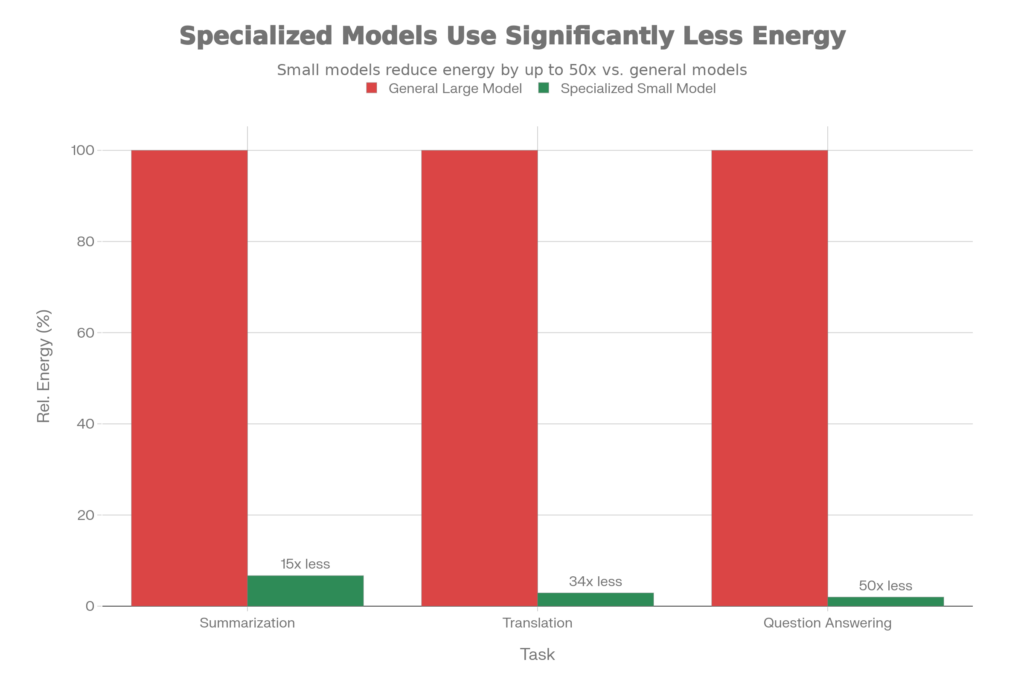
This is where Green AI comes in. It’s the philosophy of using the right tool for the job. A 2025 study found that for simple tasks like translation or summarization, Specialized Small Models (SLMs) use 15x to 50x less energy than massive general models, while delivering the same accuracy.
“Training” vs. “Using”: Where’s the Carbon?
To understand the environmental cost of Green AI, we must look at the two distinct stages of an AI’s life:
1. Training (The One-Time Cost)
This is when the AI “goes to school.” Teaching a massive model requires thousands of GPUs to run for months. It’s estimated that training a single mega-model can emit as much carbon as five cars driven for their entire lifetimes.
2. Inference (The Daily Cost)
This is when you use the AI. Every time you hit “Enter” on a prompt, a server somewhere spins up. In 2025, inference has become the silent killer. Because billions of people are now using AI daily, inference accounts for 80-90% of the total energy consumed by AI.
Green AI focuses heavily on fixing this “inference” problem. If we can make daily queries cheaper and lighter, the total impact drops drastically.
The Solution: How We Build Green AI
Green AI isn’t about stopping progress. It’s about being smarter. It’s the shift from “Red AI” (buying performance by just adding more massive chips) to “Green AI” (getting the same performance with efficiency).
Here is how the industry is fixing it (and how you can too):
1. Small is Beautiful (SLMs)
The biggest trend in late 2025 is Small Language Models (SLMs). These are models designed to do one thing well. They run faster, cost way less, and you can often run them on your own laptop without burning down a rainforest.
Action for you: Next time you build a tool, ask yourself: Do I need the biggest model for this? Or can a smaller, cheaper green AI alternative handle it?
2. Carbon-Aware Computing
This is a brilliant concept gaining traction in 2025. Carbon-aware programming means your code checks how clean the power grid is before running a heavy task.
How it works: If the sun is shining and solar energy is peaking at noon, your AI runs its training job then. If the grid is burning coal at 8 PM, the AI pauses. It’s simple, automated, and effective.
3. Green Coding Practices
Developers are now realizing that “lazy code” destroys the planet. Writing efficient code is a core tenet of Green AI.
Optimization: Instead of querying a database 1,000 times, cache the result once.
Efficient Languages: Using energy-efficient languages like Rust or C++ for heavy lifting, while keeping Python for the simple logic.
Tools for Accountability
You can’t fix what you don’t measure. In 2025, a suite of new tools has popped up to help developers track their “AI Carbon Footprint”:
Cloud Carbon Footprint: An open-source tool that connects to AWS, Google Cloud, or Azure to show you exactly how much CO2 your servers are spitting out.
Code Carbon: A Python package you can add to your code. It tracks the emissions of your specific experiment and tells you if you’re being a “Red AI” villain or a Green AI hero.
Pulsora: A top-tier tool for businesses that need “audit-ready” carbon reports to prove they are meeting sustainability goals.
Why Should You Care? (Beyond the Planet)
Okay, maybe you are a ruthless capitalist and “saving the polar bears” isn’t enough motivation for you. Here is the business case: Green AI is a cheaper AI.
Lower Latency: Smaller, greener models reply faster. Your users get answers in milliseconds, not seconds.
Lower Bills: Consuming less compute means lower API costs. If you run a startup, Green AI is literally money in your pocket.
Brand Trust: In 2025, consumers are smart. They prefer brands that aren’t wasteful. Being “Eco-Friendly” is a massive competitive advantage.
Case Studies: Who is Doing it Right?
It’s not just theory; big players are already making the switch to Green AI:
Unilever: They use AI to monitor over 100,000 freezers. By optimizing energy usage, they reduce waste and power consumption simultaneously.
Google: By using AI to manage the cooling systems in their own data centers, they reduced energy used for cooling by 40%.
Microsoft: They are pushing “Carbon Aware” Windows updates that only download when your local grid is using renewable energy.
The Bottom Line
We don’t need to stop using AI. We just need to stop taking the private jet to the grocery store.
By switching to smaller models, optimizing our code, and being mindful of our “digital exhaust,” we can build a future where AI helps us solve climate change rather than contributing to it. Green AI is the only way forward if we want our tech and our planet to survive.