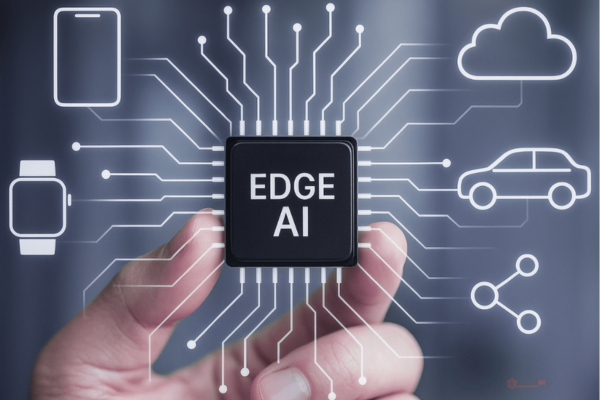
I still remember the first time I truly understood the power of edge AI technology. I was researching smart home devices, and I realized my smartphone face unlock feature worked instantly even without internet. That moment hit me: AI wasn’t just living in massive data centers anymore; it was right there in my pocket, making decisions in milliseconds.
Edge AI (Artificial Intelligence at the edge) refers to deploying AI algorithms directly on local devices like smartphones, IoT sensors, cameras, and wearables instead of relying on distant cloud servers. This means your device processes data right where it’s collected, enabling real-time decisions without sending information to the cloud.
Table of Contents
How Edge AI Technology Works
When I first started exploring edge computing AI, I was fascinated by how elegantly simple yet powerful the concept is. Traditional AI systems send your data to massive cloud data centers for processing. With edge AI, the “brain” lives on your device itself.
Here’s how the magic happens:
Training Phase: Specialized AI models are trained in the cloud using enormous datasets and powerful processors
Optimization: Models are compressed and optimized to run efficiently on AI edge devices with limited computing power
Deployment: The device uses sensors to collect data voice, images, or temperature readings
Local Processing: The embedded AI model processes information locally to make decisions instantly
I’ve seen this firsthand with my smartwatch monitoring my heart rate continuously and alerting me immediately if something seems off all without connecting to the internet. The AI model analyzing my vital signs runs directly on the watch’s tiny processor.
Edge AI vs Cloud AI: 5 Critical Differences
After testing various AI tools, I’ve learned that edge AI vs cloud AI serve different purposes. Here are the key differences:
1. Speed and Latency
Edge AI: Processes data in milliseconds locally
Cloud AI: Requires internet round-trip, adding hundreds of milliseconds
Impact: For autonomous vehicles needing split-second decisions, this difference saves lives
2. Data Privacy and Security
Edge AI: Data never leaves your device naturally more secure
Cloud AI: Data transmitted to remote server’s higher breach risk
Example: Smartphone facial recognition processes everything locally on Apple devices
3. Cost Structure
Edge AI: Reduces bandwidth usage by up to 99%, massive savings on data transfer
Cloud AI: Lower upfront costs but higher ongoing cloud computing expenses
Trade-off: Edge requires hardware investment; cloud offers virtual flexibility
4. Connectivity Requirements
Edge AI: Works completely offline
Cloud AI: Requires constant internet connection
Use Case: Smart agriculture systems monitor crops in remote fields without connectivity
5. Scalability
Edge AI: Limited by physical hardware constraints
Cloud AI: Easily scales by adding virtual computing power
Consideration: Businesses must match approach to specific needs
5 Powerful Edge AI Benefits Transforming Business
Working on my tech blog and testing AI edge devices has shown me tangible benefits beyond theory:
1. Lightning-Fast Response Times
Real-time processing transforms workflows. Voice commands on smartphones respond instantly, no waiting for distant servers. For industrial automation or medical diagnostics, these milliseconds matter enormously.
2. Enhanced Privacy and Security
Processing data locally means personal information, voice commands, and health metrics to stay on your device. In healthcare applications, patient data remains confidential while enabling predictive diagnostics.
3. Offline Functionality
I’ve tested devices in areas with poor connectivity, and edge AI technology features continue working perfectly. Disaster response drones operate without network dependency, making technology accessible everywhere.
4. Significant Cost Efficiency
By processing locally, companies reduce expensive cloud computing bills and bandwidth costs. Manufacturers report a 70% reduction in unplanned downtime and 25% lower maintenance costs through edge AI-powered predictive maintenance.
5. Energy Efficiency and Sustainability
Local processing consumes significantly less power than constant cloud communication. My fitness tracker lasts days longer because it analyzes activities on-device rather than streaming to the cloud.
Edge AI Applications: 7+ Real-World Use Cases
Through my research, I’ve discovered edge AI applications actively reshaping entire industries:
Healthcare Revolution
Wearable monitors detect irregular heart rhythms in real-time
Continuous glucose monitors analyze blood sugar on-device for diabetes patients
Medical sensors enable fast bedside diagnoses without cloud delays
Smart Manufacturing Excellence
Smart cameras provide real-time quality control on production lines
Predictive maintenance systems analyze machine data to predict failures hours before they occur
Process optimization: Food plants achieve 5% yield improvement with real-time edge AI adjustments
Autonomous Vehicles and Transportation
Self-driving cars process massive sensor data from cameras and LiDAR in milliseconds. Cloud latency would make autonomous driving impossible edge computing AI enables split-second obstacle detection and collision avoidance.
Retail and Customer Experience
Smart stores use edge AI for real-time inventory tracking through weight sensors
Video analytics monitor foot traffic patterns to optimize store layouts
Privacy-first approach: All processing happens locally
Smart Homes and IoT
Security cameras detect unusual activity with instant alerts
Smart thermostats learn preferences and adjust autonomously
Voice assistants respond to commands without internet lag
Agriculture and Environmental Monitoring
Crop monitoring systems operate in remote fields
Soil sensors provide real-time data for irrigation optimization
Weather prediction models run locally on edge devices
Industrial Safety Systems
Worker safety monitoring through wearable sensors
Hazard detection systems identify dangerous conditions instantly
Equipment monitoring prevents catastrophic failures
Edge AI Implementation Challenges
Despite incredible benefits, edge AI technology presents genuine challenges:
Hardware Limitations
AI edge devices have constrained processing power, memory, and storage compared to data centers. Developers must optimize models through quantization and pruning requiring significant technical expertise.
Power Consumption Concerns
Battery-powered devices face strict energy budgets. Standard AI models drain batteries quickly, requiring ultra-low-power designs and specialized AI chips.
Model Deployment and Updates
Managing AI models across thousands of distributed edge devices presents operational complexity. Secure updates across diverse, heterogeneous hardware environments multiply challenges.
Security Vulnerabilities
While edge AI enhances privacy, devices themselves can become cyberattack targets. Protecting distributed models requires robust security measures across expanded attack surfaces.
The Future of Edge Computing AI
As someone tracking AI trends closely, I’m excited about where edge AI technology is heading:
5G Network Integration
5G networks will supercharge edge AI applications with faster connectivity when devices need cloud collaboration. This hybrid approach edge processing for instant decisions combined with high-speed 5G represents the best of both worlds.
Federated Learning Revolution
This game-changing approach enables devices to collaboratively train AI models without sharing raw data. Each device learns locally, shares only model updates, and collectively improves the global model while preserving privacy.
Advanced AI Chips and Hardware
Companies are developing specialized processors optimized for edge AI workloads. NVIDIA Jetson, Google’s Edge TPU, and next-generation AI chips deliver dramatically improved performance with less power consumption.
Edge-Native Large Language Models
Researchers are working to deploy LLMs directly at the edge. Imagine ChatGPT-level AI running locally on your smartphone without internet that future is closer than you think.
How to Implement Edge AI Successfully
Based on research and conversations with tech professionals, here are key strategies for implementing edge computing AI:
1. Start with Clear Use Cases
Don’t adopt edge AI because it’s trendy. Identify specific problems where real-time processing, privacy, or offline functionality provides genuine value. Define measurable objectives first.
2. Choose the Right Technology Stack
Match hardware and software to your needs:
Hardware: NVIDIA Jetson, Intel Movidius, Google Edge TPU
Software: TensorFlow Lite, PyTorch Mobile, Edge Impulse
Principle: Use appropriate technology don’t over-engineer
3. Begin with Pilot Projects
Launch limited pilots with clear KPIs like latency reduction, accuracy improvements, or cost savings. Learn before scaling across your organization.
4. Prioritize Data Strategy
Quality training data remains crucial. Develop processes for collecting, labeling, and managing data throughout the AI lifecycle. Plan how edge devices share insights with cloud systems.
5. Build Security from the Start
Implement robust security measures to protect distributed AI models. Address privacy regulations like GDPR proactively by designing systems that process data locally.
6. Plan for Lifecycle Management
Develop MLOps pipelines specifically for edge deployments, including model versioning, secure updates, and monitoring across distributed devices.
Edge AI and Privacy: Why It Matters in 2025
Privacy concerns have become increasingly important, and edge AI technology addresses these issues fundamentally:
By processing data locally, edge AI eliminates transmitting sensitive information across networks to distant servers. This dramatically reduces exposure to data breaches and unauthorized access.
Edge AI enables GDPR and CCPA compliance more naturally. When data never leaves the device, regulatory compliance becomes simpler and more trustworthy.
Privacy-enhancing features in edge AI cameras include automatic face redaction and event-based recording, providing security benefits while respecting privacy.
Conclusion: Edge AI Is Reshaping Our Digital Future
My journey exploring edge computing AI has transformed how I understand artificial intelligence’s role in our lives. We’re experiencing a paradigm shift from centralized cloud computing to distributed intelligence at the edge.
This isn’t just technical evolution it’s enabling entirely new applications. Real-time healthcare monitoring, autonomous vehicles, smart cities, and privacy-preserving AI are becoming reality because of edge AI.
The benefits are tangible: instant response times, enhanced privacy, offline functionality, cost savings, and energy efficiency. These advantages make edge AI essential for modern applications demanding speed and security.
For businesses, the message is clear: edge AI technology represents a competitive advantage in 2025 and beyond. Organizations successfully integrating edge AI will deliver better customer experiences, operate more efficiently, and maintain stronger security.
Whether you’re a business leader, developer, or technology enthusiast, understanding edge AI is essential for navigating our AI-powered world.
Frequently Asked Questions
What is the main difference between edge AI and cloud AI?
Edge AI processes data locally on devices where it’s generated, enabling real-time responses and enhanced privacy. Cloud AI sends data to remote servers for processing, offering greater scalability but with higher latency and potential privacy concerns.
Does edge AI need an internet connection to work?
No, one of edge AI’s key advantages is complete offline functionality. Since processing happens locally on the device, internet connectivity isn’t required for core AI functionality, though some applications use hybrid approaches.
What industries benefit from edge AI?
Healthcare, manufacturing, retail, automotive, and agriculture lead edge AI adoption. Any industry requiring real-time decision-making, enhanced privacy, or operation in limited-connectivity environments benefit significantly.
How does edge AI improve privacy compared to cloud AI?
Edge AI keeps sensitive data on the device rather than transmitting it to external servers, dramatically reducing breach of exposure. This local processing makes GDPR compliance simpler and builds greater user trust.
What are the biggest challenges in implementing edge AI?
Key challenges include limited computational resources on edge devices, power consumption constraints for battery-operated devices, deployment complexity across distributed devices, and ensuring security across numerous endpoints.
Is edge AI more expensive than cloud AI?
Edge AI requires upfront hardware investment but reduces ongoing operational costs through lower bandwidth usage and reduced cloud computing expenses. Cloud AI has lower initial costs but higher long-term operational expenses.
What devices commonly use edge AI?
Smartphones, smartwatches, fitness trackers, smart home devices, security cameras, autonomous vehicles, industrial sensors, and IoT devices all commonly incorporate edge AI capabilities.
How will 5G impact AI adoption?
5G networks will enhance edge AI by providing faster, more reliable connectivity when devices need cloud communication, enabling hybrid architectures combining local processing with cloud collaboration.
Related Articles:
External Resources: