The Shift Happening Right Now: From ChatGPT to AI Agents

I was in a meeting three weeks ago where my friend asked, “What’s the difference between ChatGPT and these new AI agents everyone’s talking about?”
That question stuck with me because it highlighted something important: we’re at an inflection point in artificial intelligence. We’ve moved past the phase where AI just responds to prompts. We’re now entering the era of AI that actually does things—independently, without you having to tell it every step.
This is the story of AI agents. And honestly, it’s more significant than most people realize.
According to Kyndryl’s 2025 Readiness Report, 87% of business leaders believe AI will completely reshape jobs in organizations within the next few years. When you dive deeper, most of that transformation is not about incremental improvements. It’s about AI driven agents autonomous systems that can reason, plan, and execute tasks with minimal human intervention.
So i decided to talk about what AI agents actually are, how they differ from the AI you have been using, and why this matters for your business or career.
AI Agents vs. Chatbots: The Fundamental Difference

Here’s the core distinction that most people miss: Chatbots answer questions. AI agents accomplish tasks.
Think about how you use ChatGPT today. You ask it something. It thinks for a bit. It responds. Then you read the response. Maybe you ask a follow-up question. Maybe you copy-paste the response somewhere. Maybe you use it to do more work. But ChatGPT itself isn’t doing any of that, You are. ChatGPT responds that’s it.
An AI driven agent is different. An agent can:
- Break down a complex goal into smaller steps
- Execute those steps (actually running functions, calling APIs, accessing databases)
- Evaluate whether each step worked
- Adjust its approach if something failed
- Continue until the goal is accomplished
- Report back what it did and why
The terminology is important for this reason. In 2025, “agentic AI” will refer to a technology that is essentially more powerful than chatbots as they exist today.
Real Example: You ask to ChatGPT, “I need to analyze our Q4 sales data and send a summary to the team by noon.”
ChatGPT would tell you how to do that. It might write some SQL code for you. It might suggest what metrics to include in the summary. But an AI agent would actually run the queries, pull the data, create the analysis, format it nicely, and send it to everyone’s inboxes. By noon. Without you doing anything else.
This isn’t science fiction. This is happening now in November 2025.
How AI Agents Actually Work (Simplified)
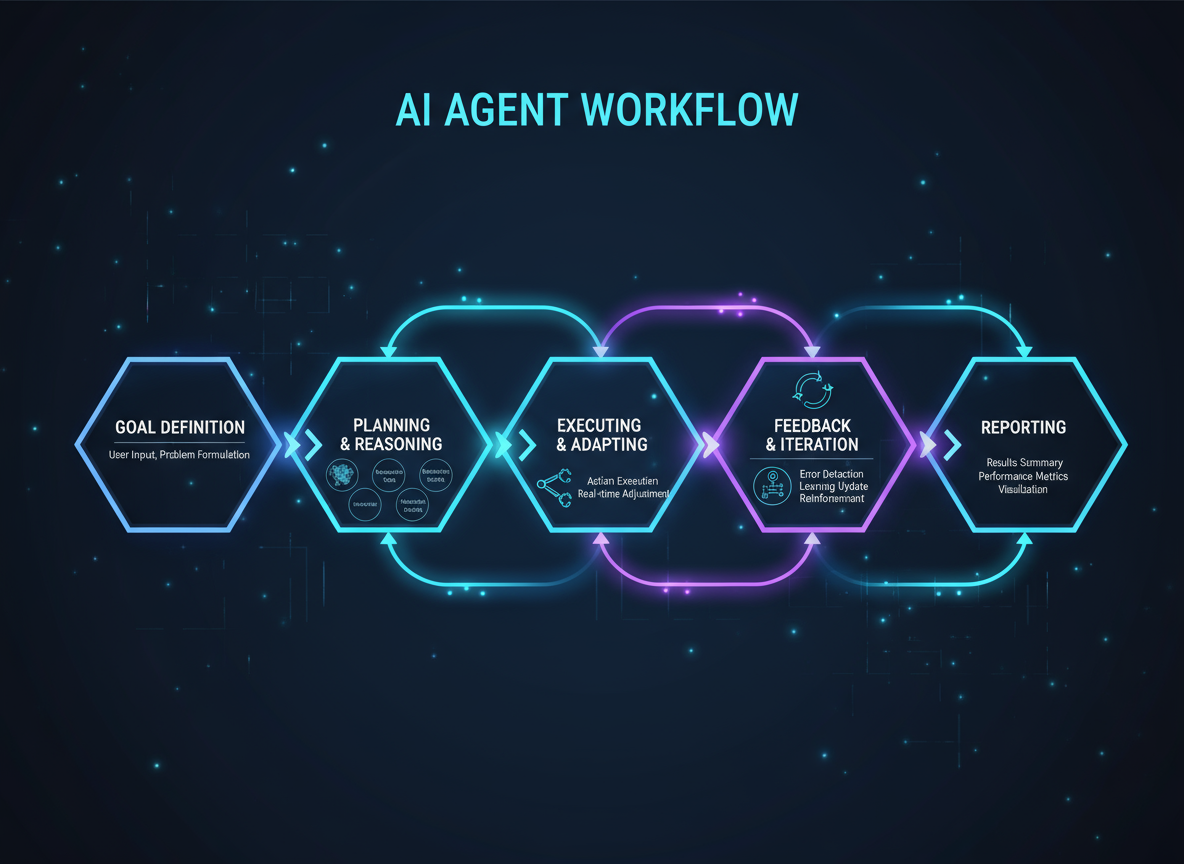
Understand the process, that helps you appreciate why everyone’s talking about this.
Step 1: Goal Definition
Everything starts with a goal. The goal needs to be clear enough that an AI can work with it but flexible enough that the AI can figure out multiple approaches.
Instead of: “Do X and then do Y”
Better: “Get me the monthly sales report”
The agent needs to figure out the “how.”
Step 2: Planning & Reasoning
This is where agents use reasoning models (like OpenAI’s or Anthropic’s Claude with extended thinking). The agent breaks the goal into sub-tasks:
- Where is the sales data stored?
- What time period do they need?
- What format should the report be in?
- Who needs to see it?
- What analysis adds value?
The agent reasons through this without you spelling it out.
Step 3: Executing & Adapting
Here’s where it gets interesting. The agent has access to tools APIs, databases, email systems, CRM software, etc. It can actually execute actions.
If the agent tries to pull data and gets an error, it doesn’t just fail. It adapts. It tries a different approach. It might ask for clarification if something is genuinely ambiguous.
Step 4: Feedback & Iteration
The agent checks whether what it did actually accomplished the goal. If the revenue report it generated doesn’t look right, it fixes it. If the email failed to send, it tries again or reports the issue to you.
Step 5: Reporting
Finally, the agent tells you what it did, why it did it, and what the results were. This transparency is crucial you need to understand what your AI agent just did in your systems.
Real-World AI Agents Already Changing Things in 2025
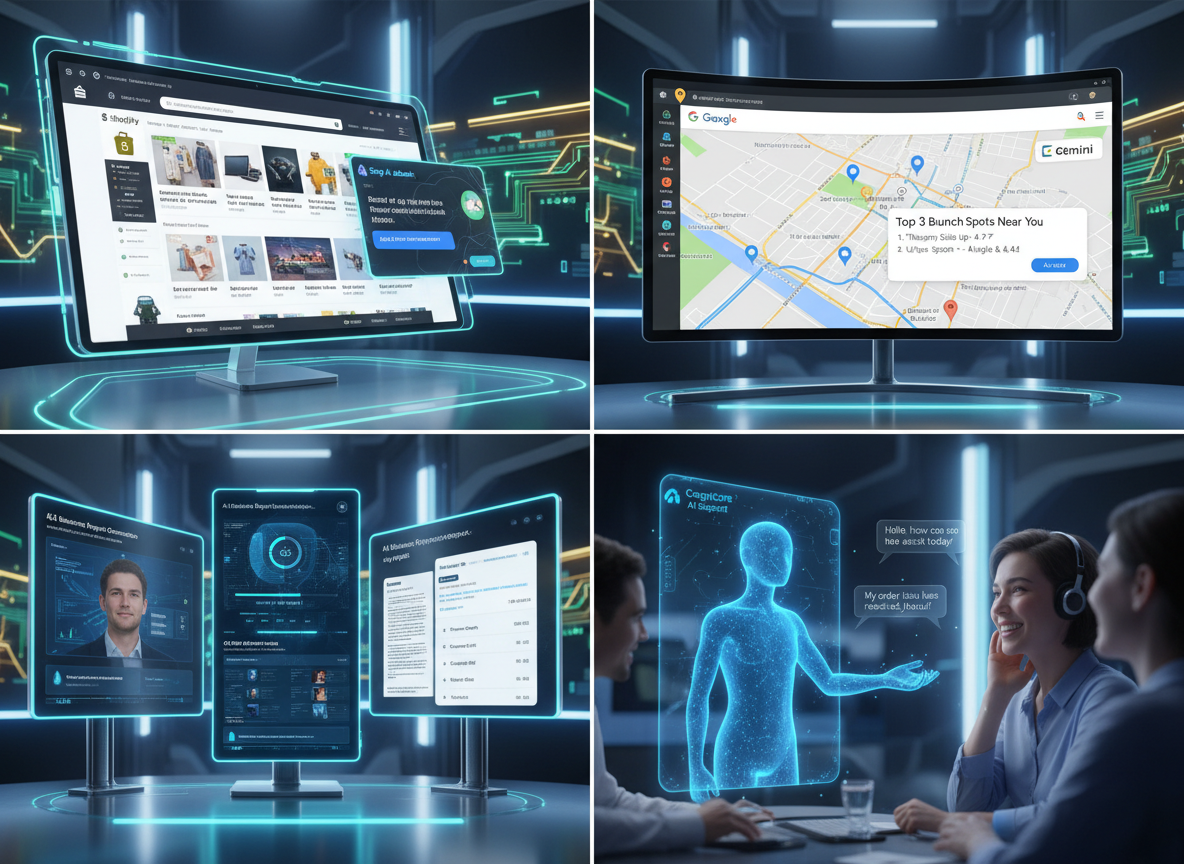
This isn’t theoretical. These are actual deployments happening now.
Sales & Customer Discovery
Shopify reported in November 2025 that agentic AI is driving 11x more orders from AI searches. Here’s what that means: when you ask ChatGPT where to buy something, an AI agent on Shopify’s side is now actually handling the shopping experience. It’s not just a link. It’s an agent that understands your question, searches inventory, compares options, and facilitates checkout all autonomously.
Shopify’s seen 7x growth in AI-driven traffic since January 2025. That acceleration is directly tied to AI agents becoming smarter and more reliable.
Mapping & Navigation
Google announced updates to Google Maps where Gemini (an AI agent) can now understand natural language questions while you’re driving. “Find me a vegan restaurant with outdoor seating near my destination” isn’t just a search query anymore. An AI agent breaks that down, understands vegan cuisine, checks Google’s database of 250 million places, cross-references outdoor seating info, considers your route, and suggests actual restaurants in real-time.
You’re not searching and clicking. An agent is doing all of that for you.
Business Intelligence & Reports
Google’s Deep Research feature (part of Gemini) can now analyze your Gmail, Google Drive files, Docs, Sheets, and Chat to build comprehensive reports. You describe what you need. The AI agent:
- Plans what information it needs
- Accesses your relevant files
- Extracts key data
- Performs analysis
- Compiles a report with citations
- Lets you refine it if needed
This used to require an hour of human work. An AI agent does it in minutes.
Customer Support At Scale
Around 90% of customers expect instant support, according to HubSpot. AI agents in customer service aren’t just chatbots giving scripted answers anymore. They can understand your issue, search multiple knowledge bases simultaneously, understand context from your past interactions, and actually solve problems or escalate to humans appropriately.
Companies like Amazon are using AI agents to handle significantly more support volume with fewer people.
Why AI Agents Matter for Jobs & Organizations

This brings us back to that statistic: 87% of leaders think AI will reshape jobs. Here’s why that’s not just corporate speak it’s practical reality.
Jobs That Change (Not Disappear)
Data Analysts: Instead of spending 40% of their time on report generation, they’ll spend that time interpreting findings and making recommendations. An AI agent handles the busywork.
Customer Service Reps: Instead of handling routine inquiries, they’ll focus on complex issues that need human empathy and judgment. AI agents triage and resolve the easy stuff.
Sales Operations: Instead of manually updating CRM systems and creating reports, they’ll focus on strategy and pipeline optimization.
IT Support: Tier-1 support (password resets, simple troubleshooting) gets handled by AI agents. Humans focus on complex infrastructure issues.
The jobs aren’t disappearing. The nature of the work is changing dramatically.
Skills That Matter
If you’re worried about your role in a world of AI agents, here’s what actually matters:
Prompt Engineering & Agent Oversight: Defining what you want AI agents to do and reviewing their work is becoming a core skill.
System Thinking: Understanding how different AI agents interact with each other and with human workflows.
Complex Problem Solving: The stuff that requires judgment, creativity, and nuance that’s what humans do while agents handle the rest.
Change Management: Someone needs to help organizations adapt to AI agents. That’s an increasingly valuable skill.
The Technical Reality: What Makes AI Agents Possible Right Now
Three recent breakthroughs made AI agents practical in 2025.
Reasoning Models
GPT-o1 and Claude with extended thinking don’t just give fast answers. They reason through problems step-by-step, much like how humans think. This makes them much better at planning multi-step tasks that AI agents need to execute.
Multimodal Capabilities
AI agents can now process text, images, documents, and video. This means they can understand complex problems that involve multiple types of information.
Tool Integration
The ecosystem of APIs and integrations has matured. AI agents can now reliably connect to databases, CRM systems, email platforms, payment systems, calendars, and thousands of other tools. When something goes wrong, they can handle errors gracefully.
Put these three things together and you get reliable AI agents that can actually accomplish real work.
The Current Limitations (AI Agents Aren’t Perfect)
Let’s be honest: AI agents today have real limitations.
Hallucinations Still Happen
AI agents can confidently give you wrong information. They reason through problems well, but reasoning isn’t the same as truth. A well-designed AI agent system includes verification steps and human review for critical tasks.
Long Task Chains Fail
If an AI agent needs to execute 20 steps perfectly in sequence, and there’s no tolerance for errors, it will eventually fail. This is why AI agents work well for tasks that are somewhat forgiving or have automatic verification.
Reasoning Can Be Slow
When AI agents use reasoning models to plan complex tasks, it takes time. Sometimes longer than just asking a human. This is improving, but it’s a real constraint for time-sensitive work.
Context Windows Matter
An AI agent needs to understand the full context of what it’s doing. If the task is too complex or involves too much information, even current models struggle.
Trust & Transparency Issues
Many AI agents are black boxes. You don’t understand why they made certain decisions. This is particularly problematic for high-stakes decisions like financial analysis or medical recommendations. Building trustworthy AI systems that explain their reasoning is becoming crucial, and that’s why custom AI solutions are important—you can build in transparency and human oversight.
How Companies Are Actually Deploying AI Agents in 2025
The most interesting deployments aren’t the flashy ones. They’re the practical ones quietly saving thousands of hours.
Enterprise Knowledge Management
Large organizations are deploying AI agents that can access internal documentation, past projects, decision logs, and employee expertise to answer employee questions instantly. Instead of 15 people searching different systems, one AI agent finds the answer in seconds.
Lead Qualification
Sales teams are using AI agents to qualify leads autonomously. The agent reviews prospect behavior, firmographic data, engagement history, and company information to determine fit before humans ever see the lead.
Meeting Notes & Follow-up
AI agents now join meetings, transcribe them, summarize key decisions, create action items, send follow-up emails, and update CRM systems. Meetings that used to require 1-2 hours of admin work afterward now take minutes.
Inventory & Supply Chain
AI agents monitor inventory levels, predict demand using historical data and market signals, automatically place orders with suppliers, and coordinate logistics. All without human intervention unless something goes wrong.
Content Generation at Scale
News organizations, ecommerce sites, and marketing teams are using AI agents to generate content, optimize it, test variations, and publish—with human review at critical checkpoints. The volume of content a small team can produce has increased dramatically.
The AI Agent Landscape: Who’s Building What
The ecosystem is fragmented, but there are clear leaders.
OpenAI is focusing on agents with access to GPT-4 and o1 models. Their API lets developers build custom agents. Gradually, OpenAI will release more autonomous features in ChatGPT itself.
Anthropic is emphasizing trustworthy, transparent agents with extended reasoning capabilities. Claude’s ability to understand complex contexts makes it popular for enterprise AI agents.
Google is integrating agentic capabilities across its products Search, Workspace, Maps, etc. Their Gemini models power these agent experiences.
Microsoft is building agents through its Copilot ecosystem and partnerships. The goal is agents embedded in existing enterprise software that people already use.
Specialized companies like Twelve Labs, Phind, and Perplexity are building vertical agents for specific industries or use cases.
The real action, though, is with organizations building custom AI agents for their specific needs. Using no-code platforms or APIs, companies are creating agents tailored to their workflows rather than forcing workflows into generic tools.
Building Your First AI Agent: Practical Steps
If you want to experiment with AI agents, here’s where to start.
Option 1: Use Existing Platforms
OpenAI’s Agent Builder: Define what you want an agent to do, give it access to specific APIs, and let it work.
Anthropic’s Claude API: Build custom agents using Claude’s reasoning capabilities and tool access.
Google’s Gemini Agent Framework: Similar approach with Google’s models and APIs.
Zapier, Make, or IFTTT: These automation platforms now have AI agent capabilities. You can create fairly sophisticated agents without coding.
Option 2: Simple Python Implementation
If you’re technical, you can build agents in Python using frameworks like LangChain or AutoGen. Connect an LLM to APIs and tools, and you have a basic agent.
Option 3: Specialized No-Code Platforms
Platforms specifically designed for AI agents (like those you can create with no-code AI builders) let you design complex agent workflows without any coding at all. You define:
- What the agent should do
- What tools it has access to
- How it should verify its work
- When to involve humans
Then the platform handles the technical implementation.
Your First Agent: Keep It Simple
Don’t start trying to automate your entire business. Start with one specific task that:
- Happens regularly
- Involves multiple steps
- Currently wastes human time
- Has clear success criteria
Maybe it’s processing customer inquiries and sorting them by category. Maybe it’s analyzing website data and generating reports. Maybe it’s managing your email follow-ups.
Start there. Let an AI automation tools handle it for a week. Refine the system. Then expand.
The Realistic Timeline for AI Agents to Matter
Here’s when you should expect different impacts:
Already Here (Late 2025):
- AI agents handling routine customer service inquiries
- Automated data analysis and reporting
- AI agents for personal productivity (scheduling, research, summarization)
- Industry-specific vertical agents (legal, medical, financial analysis)
Coming in 2026:
- Widespread adoption in mid-market companies
- AI agents becoming standard in enterprise software
- Significant job market shifts as roles evolve
- More sophisticated reasoning models making agents more reliable
2027 and Beyond:
- AI automation tools operating semi-independently across complex business processes
- Regulatory frameworks emerging for AI agent oversight
- New job categories created to manage AI agent systems
- Potential AGI-level capabilities (though this is speculative)
The Real Questions You Should Be Asking
If you’re leading an organization or managing your career, here are the questions that actually matter about AI agents:
For Business Leaders:
- Which business processes can be improved by AI agents?
- Do we have the infrastructure and data quality for AI agents to work?
- How do we ensure AI agents don’t make costly errors?
- What skills do we need to hire or develop?
- How do we handle the organizational changes this creates?
For Individual Contributors:
- Which parts of my job can be automated by AI-driven systems?
- What skills will be more valuable in a world where AI agents handle routine work?
- How do I learn to work alongside AI agents effectively?
- What’s my learning strategy for the next 12-24 months?
For Everyone:
- What safeguards should be in place for autonomous AI systems?
- How do we ensure AI agents don’t amplify bias or make discriminatory decisions?
- What’s the path for humans to stay in control?
The Bottom Line on AI Agents in 2025
AI agents aren’t coming. They’re here. Right now, in November 2025, companies are deploying them, customers are interacting with them, and workers are adapting to them.
The shift from “AI that responds to prompts” to “AI that accomplishes goals autonomously” is the most significant change in technology since the web went mainstream.
This isn’t hyperbole. This is based on what’s actually happening:
- Shopify seeing 11x order growth through agentic AI
- 87% of leaders expecting AI agents to reshape jobs
- Enterprise deployments handling critical business processes
- Customers using AI agents without realizing it
The question isn’t whether AI agents will matter. They already do. The question is whether you’ll adapt to them or be left behind by them.
If I were you, I’d spend the next 30 days understanding how AI agents work, experimenting with simple ones, and thinking about where they could add value in your specific situation.
Start there. Everything else flows from that foundation.
Further Resources & References
Related Concept – AI Builders: If you’re interested in creating custom AI agents tailored to your business needs beyond generic platforms, exploring no-code AI builders can show you how organizations create custom solutions without hiring expensive development teams.
External Resources:
- Kyndryl’s 2025 AI Readiness Report – Real data on enterprise AI adoption
- McKinsey Global Survey 2025 – Quarterly insights on AI in organizations
- Google I/O 2025 AI Announcements – Latest on AI agents in Search and Workspace
- OpenAI Agent Builder Documentation – Technical implementation guidance
- Shopify AI Commerce Report – Real e-commerce AI agent impacts